
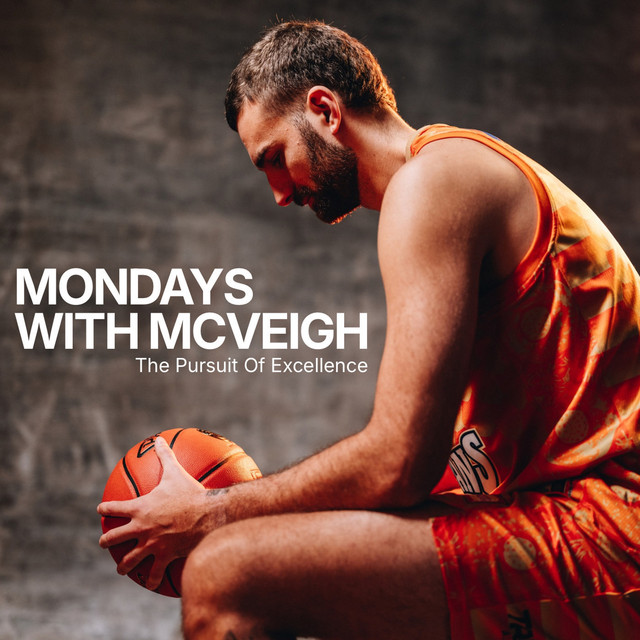
Listen to The Podcast Above
Our team's record is 14 wins and 4 losses. We are the best team in Puerto Rico. We've just won another game and coach is giving his speech in the locker room. During the game, the rooks struggled to impact winning how they would have liked, and coach knows why. They don't know who they are as basketball players yet. As an example he goes around the room and describes the vets with one or two words. Our point guard Derrick Walton, advantage creator. Pablo our captain, ball pressure. Then he looks at me.
Closer.
Tim tells me afterwards: closer is the best compliment you can be given in basketball.
Later that night a basketball Instagram page posted the league's leading clutch players. I was 3rd in percentage and 5th in attempts in the final two minutes of close games.
I wasn't born clutch. I don't have some special gene or magical touch. I've actually been the complete opposite for most of my career. Especially in college.
We had travelled to LA to play in a pre conference tournament. My season had been going well so I was excited to get there and keep the momentum rolling. The game went as expected, point for point, tough baskets and great defence. With 20 seconds left our team had the ball and we were up by 5. All we had to do was catch the ball and make some free throws. Simple. Percentages showed I was our best free throw shooter, so I was in the action to get the ball. I set a cross screen for our point guard, they double him for a split second, so the inbounder passes me the ball. I grab it with both hands, ready to be fouled. They trap me in the double. I twist my arms to protect the ball, but the smaller defender snatches it from me. He kicks it out to the three. Boom. It's in. Our team rushes the ball out and passes it back to me again. I hold it with all my life this time. They foul me. I stagger the length of the court. I feel my shoulders get heavier and heavier. I look at my coach and I swear his legs are shaking. My head is loud. Okay, I think to myself, we are only up 2, I can't miss these. I step to the line. I take a big breath, but all I feel in my lungs is don't miss don't miss. I shoot the ball. It feels good. It clanks off the back rim.
They tell me I missed the second one too. I don't remember it. The game went dark and moved too fast. I was in my hotel bed later that night, mindlessly scrolling through Instagram to block it all out. How did I turn it over and miss both free throws. Why am I such a choke artist. I can't believe they hit back to back threes to win the game.
This game really fucked me up. The humiliation bled into my first quarter, my open shots, my drives, and over time into practices and workouts. I viewed myself as a choke artist. Someone who crumbled under pressure. Someone who needed the situation to be perfect to succeed. Something had to change. I dived into sports psychology and philosophy to learn how to become clutch. It was a 7 year journey. This is how I went from being a choke artist to hitting a game tying shot against the Oklahoma City Thunder, performing in the Olympics and making arguably one of the biggest shots in NBL history.
I hated high school. It was torture sitting down all day. I didn't fit in the seats and the classes bored me. Besides, I knew I wanted to be a pro baller, so why would I care about geometry and geography. When I signed to go to college, I knew I had to pick a topic but had no idea what. Adam Caporn, my coach at the Australian Institute of Sport, suggested psychology because it would help me understand my mind and how to perform better. At the time I laughed it off, but in reality, it was the best decision I ever made. The classes hooked me. Learning about how the mind worked, from how it learns, to reward pathways, to rewriting who you are. When I sat down and created a plan to become clutch, it was my history with psychology that helped me start. In particular, a psychologist by the name of Carl Jung and his ideas about the subconscious mind.
Most of who you are is happening underneath.
Picture an iceberg. The tip above the water is your conscious mind, your logical thinking and current awareness, about 10% of the whole thing. The other 90% sits under the water. Automated habits, forgotten memories, deep emotional drives. When you pick an outfit, send a text, or decide what to eat for dinner, that 90% is making most of the calls. You just don't see it.
Every second, your brain takes in around 11 million bits of information. Your conscious mind can only process about 50 of them. The rest gets handled underneath.
It does this through story. Your subconscious takes the flood it cannot hold and shapes it into a narrative about who you are, and then you spend your life reading the world through that story without ever knowing it was written.
Your subconscious decides what you notice. It decides how your body reacts. It decides what you do before you have time to think about it.
Carl Jung said it cleaner than anyone:
Until you make the unconscious conscious, it will direct your life and you will call it fate.
That is the whole game. And it was the work I had to do.
I had to convince my subconscious mind that I was a closer.
When it was my time to rise up and answer the call in big games or moments, I choked. This wasn't a trait I was born with. It was built through years of daily habits. Poor self talk, not practising under pressure, and my beliefs about who I was. I knew that to convince my subconscious I was a closer, the answer would be the same. Daily habits. There was no eureka moment. It was a day by day process.
The first action step I took was to start building a mindfulness practice.
Mindfulness is the skill of holding your attention on one thing, noticing when it drifts, and bringing it back without judging yourself for leaving. That's it. You sit, you breathe, you watch your mind wander, you return. It sounds soft until you try it and realise how hard it is. In that attention building exercise, you become the observer. I would sit still, my mind would wander, I would notice what I was thinking about, and bring my attention back to my breath.
You cannot change a thought you cannot catch. And under pressure, the thoughts that make you crumble move fast. "Don't miss." "You always choke." "Everyone's watching." They run underneath, before you know they're there. They tighten your chest, shorten your breath and speed the game up. Mindfulness is what slows them down enough to see.
I started on an old blue couch with the Calm app and a 30 day beginner course. Ten minutes a day. The first session was torture. I had never sat still with my eyes closed in my life. My mind raced, my body itched, I wanted to quit at three minutes. But I stuck with it. Day two, torture again. Day five I struggled again. Instead of bringing my attention back to my breath I sat there listing everything I had to do and every conversation I wished I'd handled better. This shit was hard. But I kept showing up, ten minutes every morning, day in day out. I finished the 30 day introduction and kept going. I started to enjoy the morning sits, but something more profound happened. I started to become aware, mindful and still throughout the day.
I started to catch things I had never noticed before. Coach would tear into the team and I'd feel my shoulders climb toward my ears, and for the first time I could feel it happening and relax my body. In film I'd notice my mind sprinting somewhere else and walk it back to the screen. Small moments, but they were reps. I was training the exact muscle I would need at the free throw line.
Then the moment arrived. My second year as a pro, playing NBL1 in the offseason, I stepped to the free throw line in a playoff game and heard it start. "Don't miss, don't miss." The same voice from that night in college. But this time I caught it. I recognised it for what it was. Not the truth, not a prophecy, just an old program running on autopilot. For years that voice had been the steering wheel. Now, for the first time, I could see it from the outside.
That was the first breakthrough in becoming clutch. But seeing the story is not the same as changing it. I could catch "you're a choke artist" when it fired, and catching it took away some of its power. But the voice was still there, still loud, still telling me who I was. If I wanted to become a closer, noticing the old story wasn't enough.
I had to rewrite it.
How I Rewrote My Story
I grew up in a small beach town called Cabarita Beach. The closest basketball court was a 40 minute drive with no traffic, an hour in the wrong part of the day. But that didn't stop my love for the game. My dad built me a basketball rim in the backyard and it became my favourite place in the world. I hit fadeaways like Kobe, tough and-1s like LeBron and celebrated game winners like Reggie Miller. It was the imaginary game winners I needed to reconnect with. This is where I created a clear vision of who I wanted to become. Reggie Miller. I watched his best plays. His big moments. Listened to his interviews and studied his documentary. He wasn't always the best player on the floor, but he always competed and relentlessly attacked. That's who I wanted to become. That was my North Star.
My fourth year as a pro I moved to the Tasmania JackJumpers. I made shots and competed all preseason, and it earned me the starting spot. But the season didn't start the way I planned. We were 2-6 and I was averaging 5 points per game. We were struggling on the offensive end, and I was leading that. In our most recent loss, I had one of the worst games of my career. 19 minutes and zero stats. No points. No rebounds. No assists, blocks, steals or shot attempts. It was ugly. Then Covid hit our team and we were forced into two weeks of mandatory house quarantine. On the very first day, I stumbled upon a book that introduced me to visualisation and affirmations. Think and Grow Rich by Napoleon Hill. I started immediately. Every morning and night I would write on a piece of paper: I Jack McVeigh make big shots. I would visualise myself making game winners. Being aggressive in the fourth, looking, feeling and breathing like Reggie Miller. Whenever I crossed a mirror, I'd stare at myself and repeat the same process. When I did shooting drills, the same. I was using a mantra attached to visualisation to rewrite my subconscious. At first I felt like an idiot. I didn't believe what I was saying. Looking in the mirror was embarrassing. But day by day, as I said it, I started to believe it more and more. I Jack McVeigh make big shots.
But even as I was installing the new belief, the old ones were hard to burn off. When I'd miss a shot, the noise would get loud. I am not enough. I am not built for this. I am scared of messing up. This is the real work. Because of my mindfulness practice, I could catch these I am statements. Observe them. And disagree with them. How we view ourselves is expressed in our I am statements. But you aren't a stagnant being. The brain learns, adapts and rewires itself. It's called neuroplasticity. By catching how you speak about yourself and directing it toward who you are becoming, you begin to change the core of who you are. I didn't want to be a choke artist anymore. I wanted to belong on the court in the fourth quarter.
The perfect place to start training this is in a controlled environment. Going straight into a game and trying to catch and redirect your thoughts is like trying to fly a plane without training. It just won't happen.
Daniel Johnson at the Adelaide 36ers showed up before practice and did the same shooting drill every day. It was called Big Boy. You can't miss two shots in a row. You have to make 5 from 7 at each spot to move on. Practising performing under pressure. When I'd miss, I'd notice the negative self talk. Again I'd capture it and put my attention on my breath or the next rep. When I'd make big shots, I'd take a moment to acknowledge that I'm a big shot maker. Or as the game was called, a big boy.
Every day I was rewriting the story I told myself about who I was. No longer was I Jack the scared college kid. I was Jack the big shot maker. And I trusted that my mind and body would follow. But no matter how clutch I believed I was, shooting in the backyard against my brother was vastly different to shooting in the NBL. I wanted to close that gap, and to do that I had to understand where the pressure actually comes from. It comes from within. It's internal.
"Men are disturbed not by things, but by the views which they take of things." - Epictetus
The free throw line is the same distance in an empty gym as it is in a grand final. Fifteen feet. Same ball. Same rim. Same shot I have made ten thousand times.
Nothing about the shot changes. Only the meaning I attach to it.
That was the last piece of becoming clutch. Mindfulness taught me to catch the thoughts. Affirmations and visualisation taught me to rewrite them. But the pressure itself, the weight that made my shoulders heavy walking to the line in LA, that came from somewhere deeper. It came from what I had decided the shot meant.
And I had decided it meant everything.
Separating Self Worth From The Scoreboard
Back then, a missed free throw wasn't a missed free throw. It was evidence. Evidence that I wasn't good enough as a player, a man and a human being. Every close game was a referendum on my worth. Of course my body treated it like life or death. In my head, it was.
Psychologists call this contingent self worth. Your value as a person rises and falls with your results. Win, and you're enough. Lose, and you're nothing. I wrote about living on that rollercoaster after my career high against Purdue, floating for a week, then drowning in slow motion after the Indiana game seven days later. Same player. Same body. Different result.
You cannot be clutch while your worth is on the line. The stakes are too high. No routine, no breathing exercise, no mantra can calm a nervous system that believes it is fighting for its life.
So I had to lower the stakes at the source. I had to separate who I am from what I do.
Basketball is something I do. It is not who I am. I am a husband, a father, a writer, a brother, a mate. The scoreboard measures the game. It does not measure me.
I didn't believe that sentence the first hundred times I said it. But like every rewrite, repetition and action closed the gap.
The Comparison Trap
Comparison cranks the stakes higher than any crowd can.
In college I knew every stat of every player in my recruiting class. Who was projected where. Who was averaging what. Every game I played was really two games. One against the team in front of me, and one against a ghost ledger of players I had never met.
I was obsessed with checking Tanner Krebs's college stats and how much better they were than mine. Or past NBA players like Nik Stauskas, whose journey I couldn't copy no matter how hard I tried.
You cannot be present in a moment you are using as a measuring stick.
The only comparison that lowered the stakes instead of raising them was backwards. Me against who I was yesterday. The kid in the hotel bed, scrolling to block out the misses, against the man who now wants the ball with the game on the line. That gap is mine. Nobody can inflate it or deflate it. And measuring it produces gratitude instead of anxiety.
Building A Life Wide Enough
Here is the part I resisted the longest, because every coach and every hustle post told me the opposite.
Caring less about basketball made me better at basketball.
Not less committed. Less dependent. There is a difference. When basketball was my only pillar, every crack was structural. One bad game and the whole building shook. That is why I couldn't sleep. That is why the LA game bled into practices and workouts. There was nowhere for the loss to drain to.
Now the life is wide. Beth. Oaky. The writing. The businesses. The drawing pad that has nothing to do with any of it. When I walk through the door after a game, my son does not check the box score. He just wants me on the floor with him.
A wide life means a missed shot lands on solid ground instead of falling through the floor of my identity. And a strange thing happens when the miss can't destroy you. You stop protecting yourself from it. You start wanting the shot.
Gratitude, The Stake Killer
The last tool is the oldest one.
Before big moments now, I go back to the stands. Five years old, fidgeting with my ball, waiting for the quarter time siren so I could sprint onto the court for thirty seconds of shots before the referees kicked me off.
That kid would have given anything to be here. Fourth quarter. Close game. Ball in his hands.
Gratitude flips the frame. The pressure moment stops being a threat and becomes the privilege I have chased my whole life. "I have to make this" becomes "I get to take this." Same shot. Different story. And by now you know which one your body listens to.
The Closer
I'll never forget game 3 of the NBL grand final series. Down 1, with Matthew Dellavedova taking the ball out. I watched him throw it long over Chris Goulding's head, and as Milton Doyle dived to save the ball, he passed it directly to me. Ten thousand people going crazy, but for me it was silent. It felt still. I knew I belonged in that moment. Not only prepared, but that this was the moment my journey had led me to. I dribbled up the court. I checked the clock. I checked the spacing. I knew I had to pull it from deep. From the middle circle. I hit the between the legs dribble so I could hang the ball in my left hand, rose up, and flicked the ball from my left hip straight towards the hoop. The ball floated for what felt like forever. I swear I could see people putting their hands on their heads. I could hear the commentators calling it a bad shot. But none of it mattered. I Jack McVeigh make big shots.
The perfect back rim make.
I can barely remember the rest. So much adrenaline pumped through my body that my hands shook for the next hour.
Those shaking hands are the point. Becoming clutch never silenced the noise. The voice still visits. The doubt still shows up, right beside the confidence, both of them loud. What changed is that none of it drives anymore. Clutch is not the absence of the flood. It is learning to move forward inside it. Navigating the space between confidence and doubt, and taking the shot anyway.
I wasn't born clutch. I built it. Caught the stories, rewrote them, lowered the stakes until the biggest moment in the game felt like the backyard in Cabarita Beach.
Take These With You
Lower the stakes before the game, not during it. You cannot renegotiate your self worth at the free throw line. Do it in the morning. Write down what is actually at stake tonight and what is not. The game is at stake. Your worth, your family, your future self are not.
Run the "I am" audit under pressure. Notice what follows "I am" in the fourth quarter. Catch it. Disagree with it. Redirect it to who you are becoming.
Train your nervous system in controlled fire. Pressure tolerance is built like any muscle, in reps. Consequence drills like Big Boy. Free throws at full fatigue. Ten minutes of mindfulness every morning so the observer is strong before the moment needs him.
Build a framework that travels. A routine is a home you carry into hostile arenas. Mine is simple. CALM. Catch the emotions. Accept the emotions. Lock in on the breath. Move onto the next job. This tool saved me when I started to spiral in the Olympic quarterfinals.
Compare backwards only. One line in your journal after each game: what did I do tonight that the old me couldn't?