
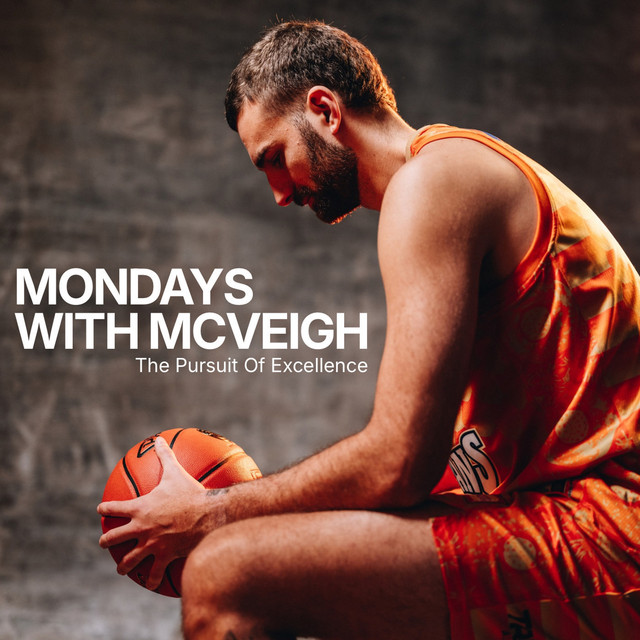
I would sit in the stands fidgeting with my basketball as I watched my older brother play under 14s club basketball. The siren would buzz for quarter time. I'd sprint onto the court and shoot as many shots as I could before the referees kicked me off. I'd giggle out loud as I ran back to my seat in the stands.
These were some of my first memories as a child. I loved basketball.
Somewhere between those quarter time sprints and a boarding school gym in a different state, something shifted.
Fast forward 10 years and my relationship with basketball had warped into something else.
I still had a desperate craving to put the ball in the hoop, but no longer was it for joy. I had moved out of home and was finishing high school in a different state, trying to make my dream of playing in the NBA a reality. The program was intense. We lifted, trained and studied film six times a week. I could feel my on court skills improving, but off court, I was struggling.
Silence had become loud. I would sit in my dorm room after training, replaying every conversation from the day. Did I say something weird at lunch? Why did he look at me like that? I would convince myself that my teammates didn't actually want me around. That they were tolerating me, not enjoying me. My legs shook with anxiety when I sat for too long. And no matter what I did, I felt like I was never good enough.
How I felt off the court started to show itself on the court. I played timid. I'd slap myself in the head when I made mistakes. I would yell at teammates and coaches when things didn't go the way I wanted.
But what affected me the most was that deep feeling that I was never enough. I wasn't good enough as a player, a man and a human being.
My days were long and nights dark. And in those twisted nights I started to tell myself a story.
"I'm not enough because I'm not in the NBA."
Your Brain Is a Narrative Machine
I didn't understand it then. But my brain was doing exactly what brains do.
Humans have been telling stories since the moment we could communicate. We are storytelling animals. Jonathan Gottschall, who studies storytelling, puts it like this: "Story is the mind's way of simulating the world. It's how we process experience, remember the past, and imagine the future. We don't experience life as a series of disconnected data points. We experience it as a story, with ourselves as the protagonist."
Stories aren't just entertainment. They help us navigate the world.
Your brain doesn't experience reality directly. It can't. There's too much information. Every second your brain receives 11 million bits of sensory information. But the human brain can only process 40 to 50 bits per second.
11 million in. 50 out.
Your brain has to decide, instantly and constantly, what matters and what doesn't. What to pay attention to and what to ignore.
It does this with stories.
The brain doesn't present you with raw data. It constructs a model of reality. This model has a structure.
It has a protagonist: you. A setting: where you are and what's happening. A past: how you got here. A future: where things are going. Causation: why things are happening. And meaning: what it all signifies.
That structure is narrative.
When you wake up in the morning you don't experience a chaotic stream of sensory data. You experience a story. I am Jack. I'm in my bedroom. It's morning. I have training today. I feel tired. Yesterday was hard.
That seamless experience is a construction. Your brain created it and presented it to your conscious mind as reality.
You're not experiencing the world. You're experiencing your brain's story about the world.
The Loop
The brain isn't just narrating the present. It's constantly creating predictions about the future.
Your brain builds a model of what it expects to happen next, compares that prediction to incoming information, and when there's a mismatch it creates a prediction error that forces an update.
But here's the key. Your predictions are based on your stories.
If your internal story is "I choke under pressure," your brain predicts choking when pressure arrives. It looks for evidence of choking. It interprets a slight tremor in your hand or a moment of doubt as confirmation. And because the brain likes to be right, it subtly influences your behaviour to confirm its expectations.
Your story becomes your prediction. Your prediction shapes your perception. Your perception guides your action. Your action confirms the story.
The loop runs automatically, beneath conscious awareness.
I didn't know any of this at the time. I just knew I couldn't sleep.
"I am not enough until I make the NBA" was a story I created in my head. No matter what I accomplished or achieved, my brain told me I still wasn't good enough because I wasn't in the NBA.
When I turned the ball over or lost my wallet, I would beat myself up for days. "If only I was better. One day I will be good enough." These messages repeated themselves over and over again.
I would predict the future: there was no point in me trying new things or learning new skills because I wouldn't be good enough at them. My entire view of the world was shaped by this story about playing in the NBA.
The Cost
This warped my relationship with basketball.
Games felt like do or die because they shaped who I was as a person. The pressure was overwhelming. I would hide in the bathroom before trainings. My body would keep me up after games replaying all the mistakes over and over again.
The pressure to make the NBA affected my performance, my improvement and my enjoyment.
No longer was I the five year old kid running onto the court for the simple love of the game. I'd grown into a miserable young man desperate to use the game to fix all my problems.
Learning to Rewrite the Stories
The end of high school flowed into college and college flowed into the NBL. I wasn't in the NBA. I still felt like I wasn't good enough. Everything was falling apart around me.
Something had to change or the rest of my life would be haunted by this voice telling me I'm not enough.
I started reading anything I could find. The Subtle Art of Not Giving a Fuck. Meditations by Marcus Aurelius. Milk and Honey, a poetry book I never would have picked up a year earlier. I talked to anyone who would listen. Teammates, coaches, family, strangers. I tried ice baths, mindfulness, journaling. Anything that might help.
It was a messy process. No single breakthrough. Just a weird concoction of desperation, curiosity and determination.
Slowly, I started to see the stories for what they were. Not truth. Just narrative. Constructed by my brain, reinforced by repetition, accepted without question.
The first story I consciously rewrote was small.
I used to tell myself "I'm just a shooter." Coaches had drilled it into me. I'd been punished for dribbling more than twice. The story became my identity.
I decided to write a different one. "I make big shots. I create mismatches. I attack."
I wrote it down every morning. I visualised it. I took actions that matched the new story, even when I didn't fully believe it yet.
Over time, my brain caught up. The prediction changed. The perception changed. The actions followed.
I'm still doing this work. There are core stories shaping how I view myself, the world, and everything in between that I'm not yet aware of. Each day I question my beliefs, my "I am" statements, my assumptions I've mistaken for truth.
When I discover a story that isn't serving me, I sit with it. I feel it. I acknowledge it. Then I work on rewriting it.
I wrote about one of those stories recently, the belief that I'm only loved when I provide value, because I'm still untangling it.
How You Can Rewrite Your Story
I've been doing this work for years. Here's where I'd start if I were beginning today.
Discovering Your Stories
The stories running your life are often invisible. You don't notice them because you're inside them. These questions can help bring them to the surface.
What do you believe about yourself that you've never questioned?
When you fail at something, what do you tell yourself it means?
What do you think you need to do or achieve before you'll feel like you're enough?
If someone secretly recorded your self talk for a week, what would they hear on repeat?
What's a story you tell about yourself that you inherited from someone else?
What would change if that story wasn't true?
The "I Am" Audit
For one week, pay attention to what follows "I am" in your head.
I am tired. I am not good enough. I am bad at this. I am always late. I am just a shooter.
Write them down. Don't judge them. Just notice.
At the end of the week, look at the list and ask:
Which of these did I choose? Which of these did I inherit? Which of these are serving me? Which of these are limiting me?
Then ask the harder question:
If I could only keep three "I am" statements, which would I choose?